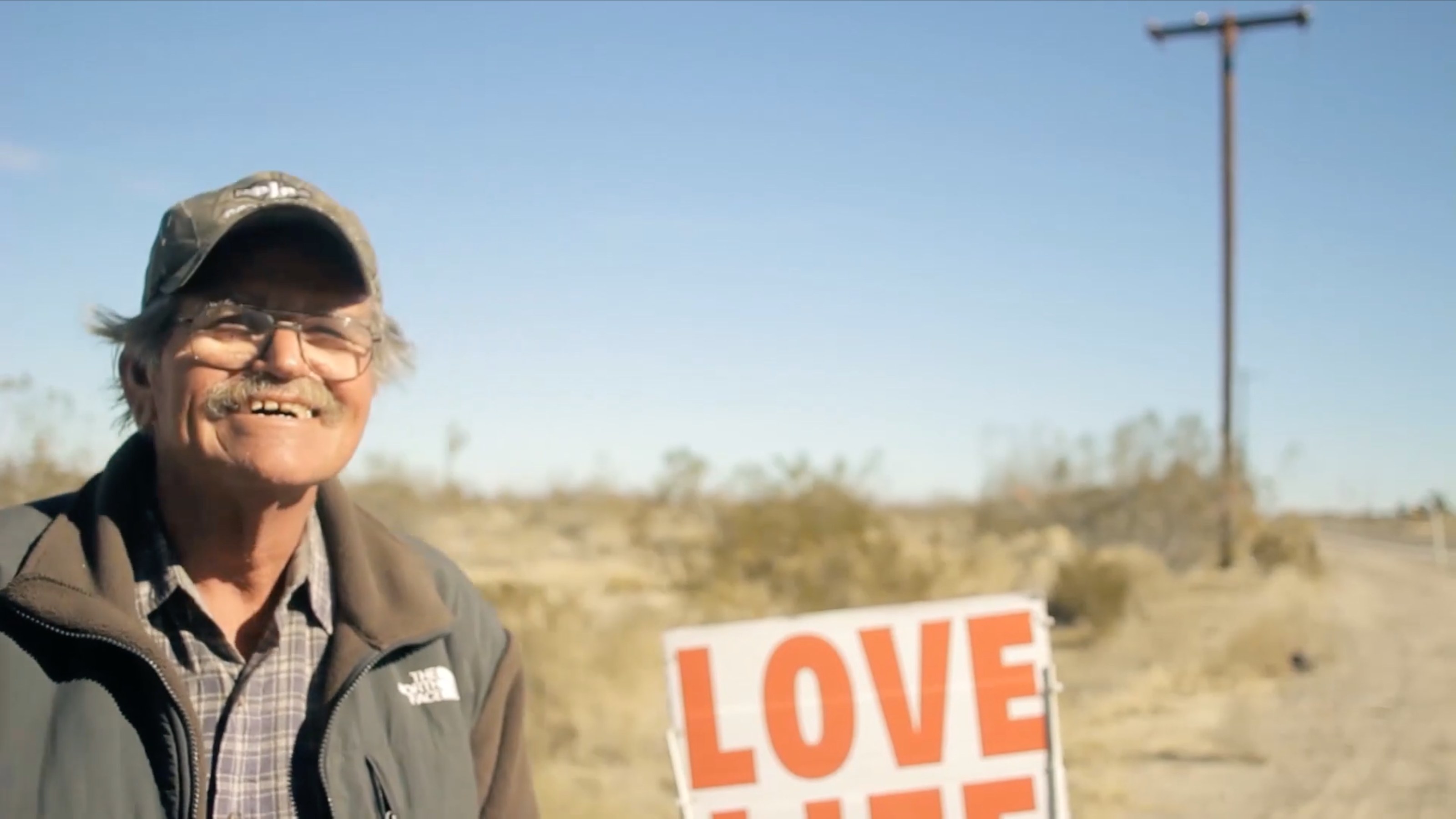
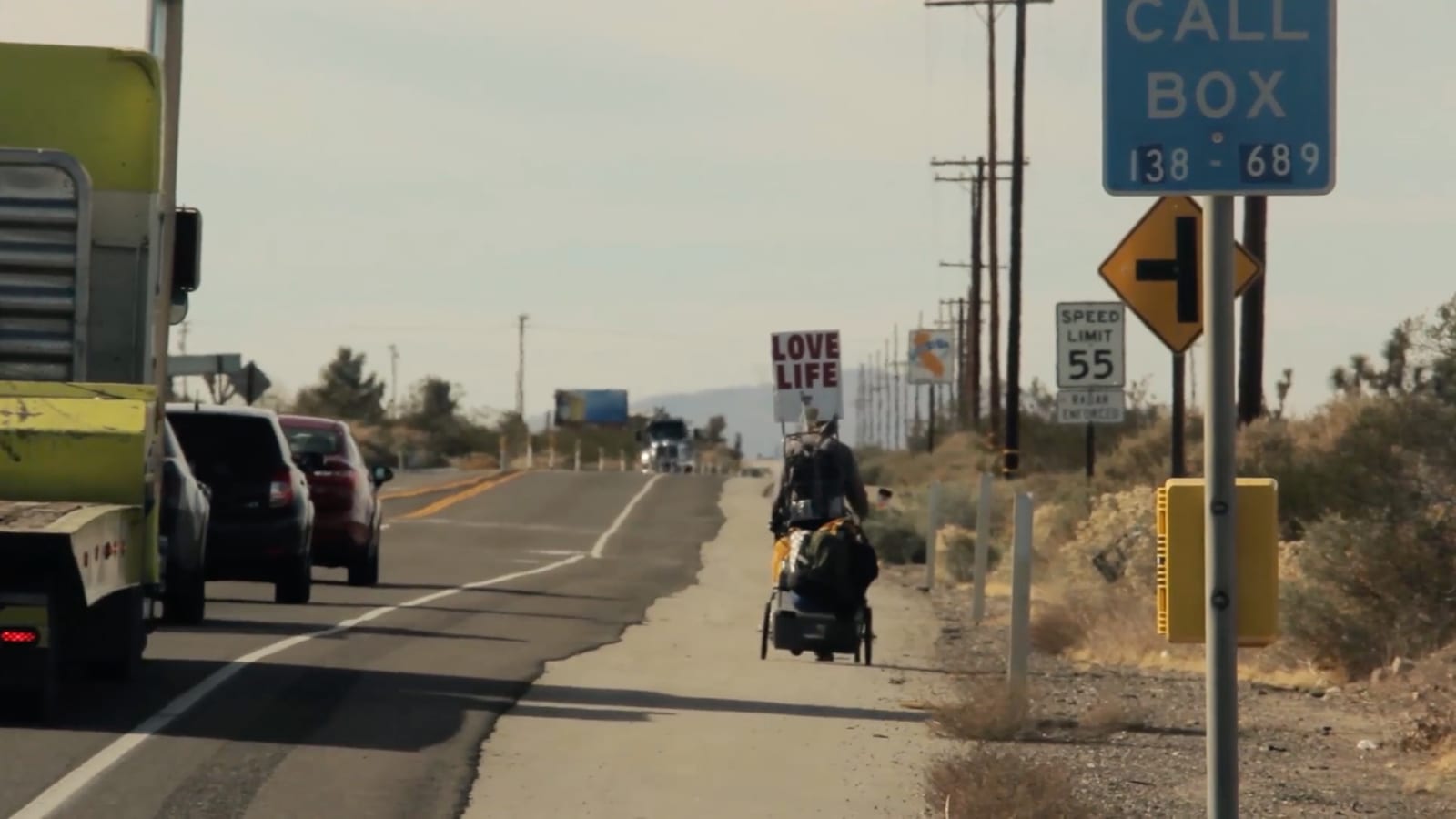
He is seventy-eight years old. He has crossed the United States nine times on foot, fifty-one thousand miles in a quarter of a century, carrying a sign that says LOVE LIFE. He buried his son in 1999 and his daughter in 2005. The walking is not what he is doing. The walking is what holds him up while he does it.
If you ask him, he will tell you the same thing he has been telling reporters for twenty-five years.
"My feet swell. My knees hurt. My legs hurt. I do not like walking."
He says it with a small smile, the way a man tells you about a difficult marriage he is going to stay in.
He lives in Vero Beach, Florida, when he is home, which is not much of the time. He served four years in the United States Navy, ran a car-cleaning business for thirty years, raised two children, was, for the first half-century of his life, the kind of American who works hard and is not on the news. In 1999, when he was fifty-two, his life broke in a way that did not put itself back together. Since then, he has walked.
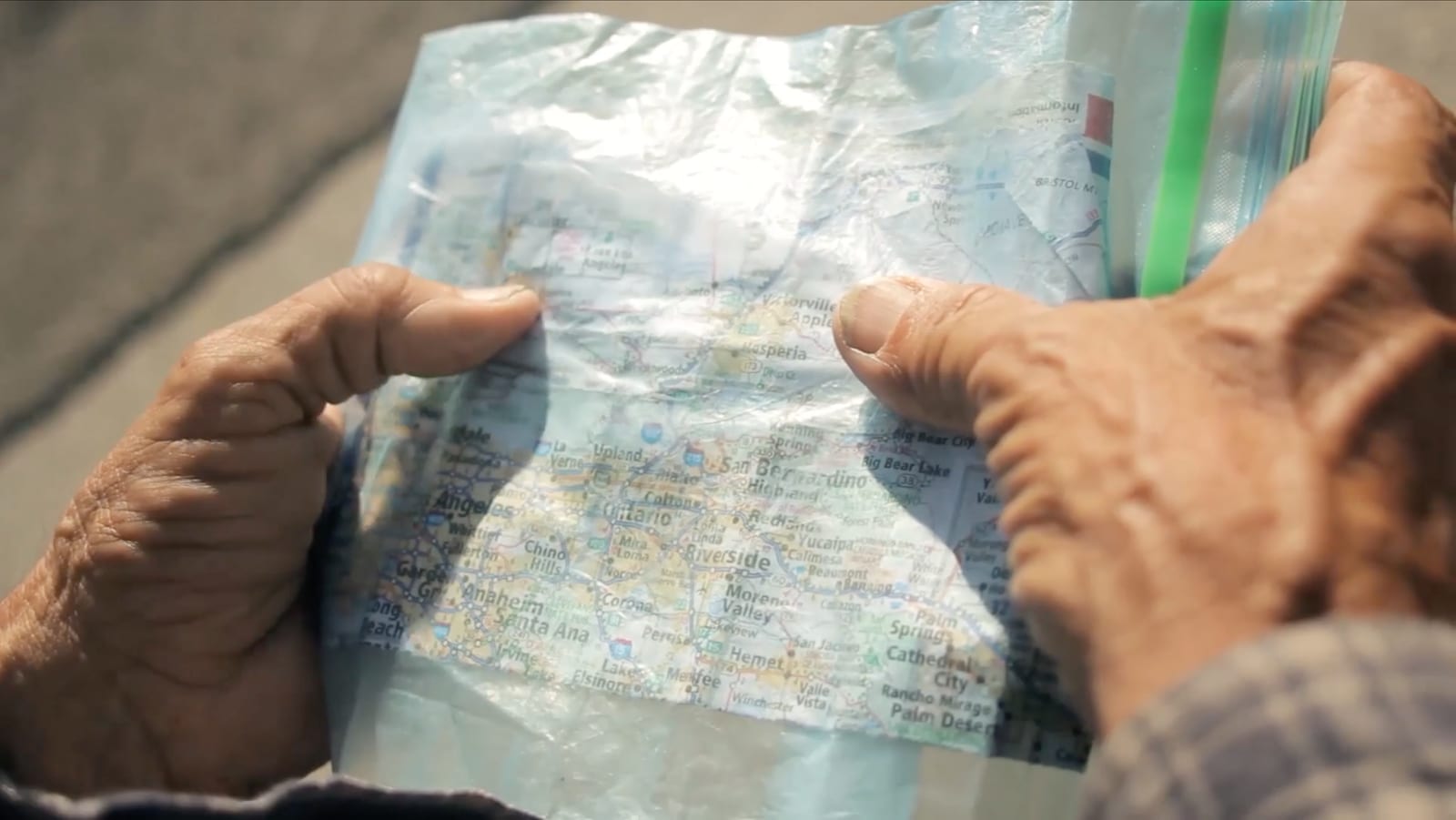
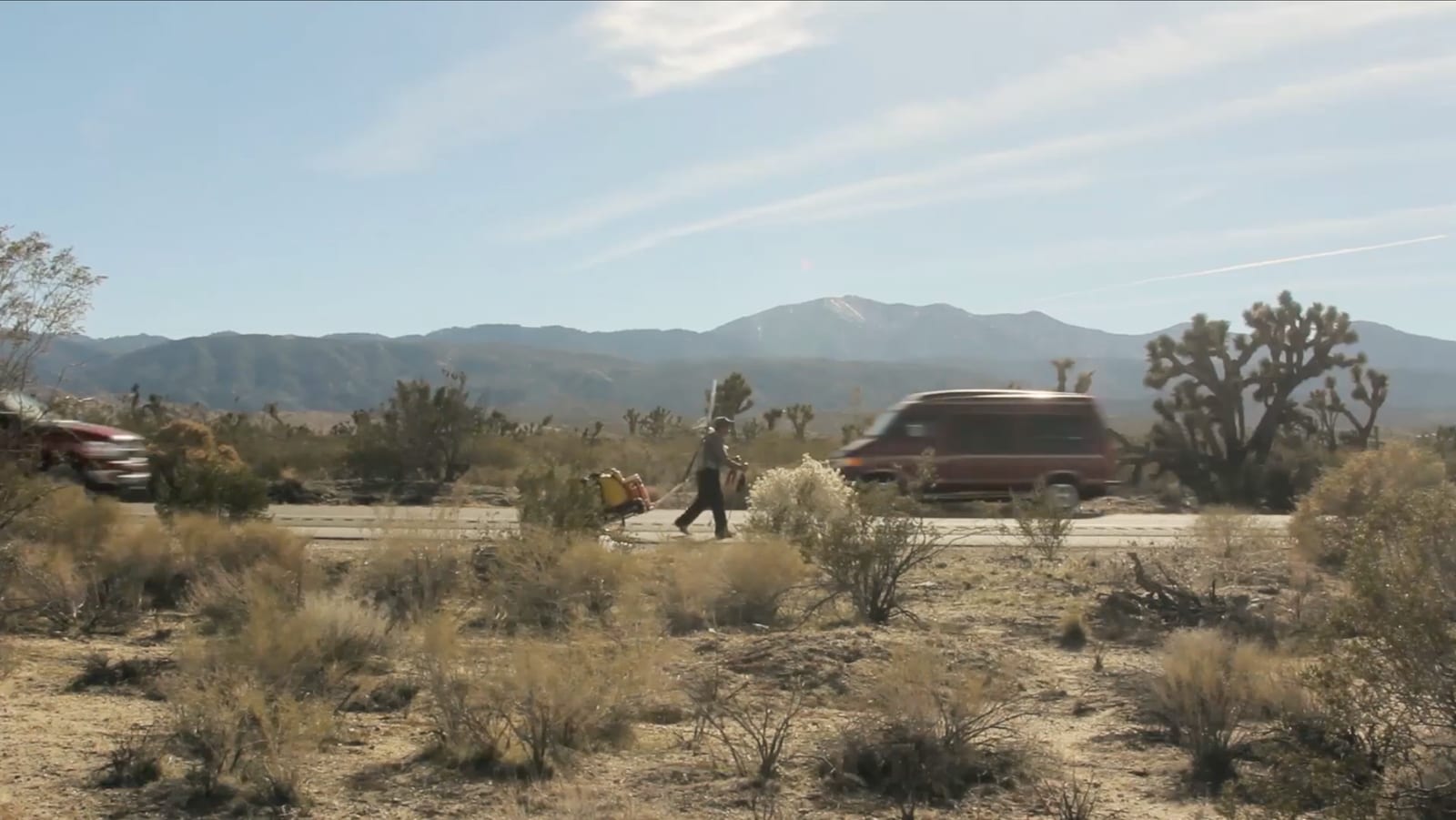
He is in the middle of his ninth crossing now. He started in October last year in Yeehaw Junction, Florida, the same kind of small inland town he has set off from before, and he is walking generally west and north and back, seven to fourteen miles a day, two days of rest in every week or so, six to eight months for the whole crossing. He does not know if he will finish this one. He says it does not really matter.
"There is no goal. There is only the walking. The walking is meeting the people and talking to the people."
He has done this nine times because of two events, six years apart, that he keeps no distance from in the telling.
In the spring of 1999, his son Stevie was twenty-six, in trouble for a drink-driving conviction, dreading the community service that came with it, and badly depressed. Steve, who had never been much of a long-distance walker, decided to take a long walk. He picked the Appalachian Trail because it was the kind of country he could imagine putting himself in for months at a time. The plan was simple and not, on its face, about Stevie at all. Steve would leave Stevie running the family business while he was gone. The work would be there. The hours would be filled. The son would have something to come back to in the evenings other than the inside of his own head. When Steve had finished the trail, he hoped that Stevie would walk it too.
Steve set off in March. By July he was in southern Pennsylvania, hard country, two thirds of the way through. The call came there. Stevie had taken his own life. There were twelve unfinished notes in his bedroom. None of them really explained why.
Steve flew home. He buried his son. He did not return to the trail for eight months. When he did, he started again where he had left it, and finished. The trail had become, by then, the only place he could be. He dedicated the rest of it to Stevie. He talked, on the trail, to anyone who would listen about depression and the people it kills. He came down off Springer Mountain in Georgia with a sentence he would repeat for the rest of his life.
"I want to mend the broken heart while it is yet beating."
He started walking across the country the following year. He bought a sign. He wrote LOVE LIFE on it in bright red letters. He carried it on a pole over his shoulder.
There is a part of this story that does not get told often, and the absence is telling. Steve did not come up with the sign by himself. He has been clear about this, more than once. "The Love Life message is a result of Shelly, my daughter, telling her dad that he should have instilled his love of life in Stevie." Shelly, six years older than her brother, said it to her father after Stevie's funeral. It was, in her telling, not an accusation. It was an instruction. The way to live with this, she told him, was to show other people what it was supposed to look like to want to be alive. The sign that has been over Steve's shoulder for twenty-five years is, in a real sense, his daughter's idea.
Five years later, Steve was on another walk. Shelly was at home in Florida. She had been diagnosed with multiple sclerosis. She was taking the medication that was supposed to help. She was, by every account, doing well. Then in 2005, while Steve was somewhere on a road, the second call came. Shelly had died. The cause was an accidental overdose of her own MS medication. She left behind a four-year-old daughter.
Steve has always believed it was an accident, and has always said so when he is asked. Not, he has been careful to point out, because believing it was an accident lets her off something. Because Shelly would never have done it on purpose. She had a child. She had the most lived-in argument against suicide he had ever met.
He has told a film crew what happened next, in his own words.
"I had over my head this sign, Love Life. And I just stood there in the middle of my screaming. I said: both of them. You have to have both of them. God, this really hurts."
After the funeral he wound down his business. He has been walking, full time, ever since.
Heroism is the usual frame, and Steve himself rejects it. "I tried every sort of group therapy there was, and it didn't work." He tried it after Stevie. He tried it again after Shelly. None of it held him. What held him was getting up, putting the sign over his shoulder, and walking. "God doesn't do group therapy, it's strictly one-on-one." He found his one-on-one on the side of the road.
He calls it trail therapy. He has called it that for so long that the phrase has settled into something formal in the press coverage. The phrase is exactly what he meant. The walking did not heal him because walking is some special activity. Sitting on his porch did not work. Driving did not work. Group did not work. Walking worked because it was slow enough that the grief could keep up with him and big enough that it had room to move around. It is the lowest, most fundamental therapy a human being has. It is what a body wants to do when a mind cannot stop.
And while he was walking, he could meet people. "When you are walking down the road and they see the Love Life sign, it tears down a lot of walls, and people say, I'm going to talk to that guy." They have done. He has been told, at various points, that he was the reason somebody put a gun down, or got out of a car, or made one more phone call. He has said, of being told that, the most honest sentence anyone has said about this kind of work. "It doesn't get any better than that."
What is worth sitting with is not the headline numbers. Fifty-one thousand miles makes a press release. Nine crossings makes a press release. The press release is not the story. The story is the daily repetition of a thing that he says he does not enjoy doing, for now twenty-five years, because nothing else will hold the weight of what he is carrying. He says he has limited his bad days to three minutes. "And it has been a long time since I have had to use those three minutes." That is not the talk of a man on a high. That is the talk of a man who has practised, every day of his life since 1999, the discipline of choosing a posture. The walking is the practice. Three-minute bad days are what twenty-five years of the practice has produced.
He has said, more than once, the line that earns its place at the end of any honest account of him.
"I have lost both my babies. If I can love my life, anybody can."
It is not a slogan. It is the report of a survey of one. He has done the experiment. He is the data.
What that means for the rest of us, who have not been hollowed out the way Steve Fugate has, is what makes him worth writing about. Most of us are not asked to walk fifty-one thousand miles. Most of us are asked, once or twice in a life, to keep going when there is no reason to except that we are still here. There is no insight in his story we could not have got from a book. There is only this. A man we have heard of, who has done the slowest possible thing in the largest possible quantity, was asked at seventy-eight what he had learned in twenty-five years on the road, and his answer was that the bad days now last three minutes.
He does not like walking. He has been doing it every day for a quarter of a century. He says, of the sign on his shoulder, that it was his daughter's idea. He is on his ninth crossing. He has thought about getting a van. He has not got a van.